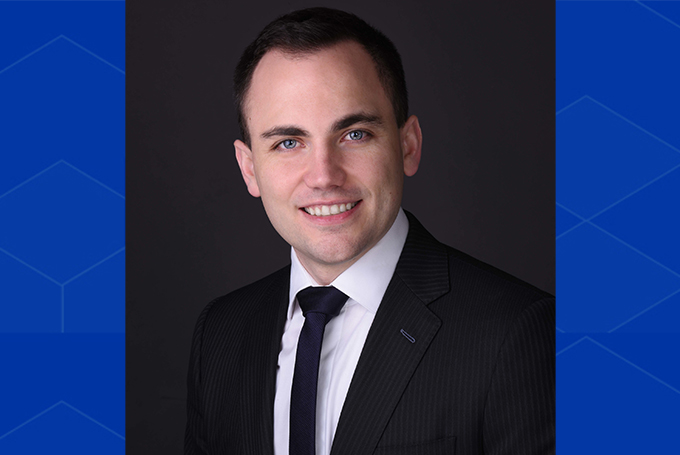
Justin Cottrell trained as a physician and surgeon, with a clinical practice focusing on hearing rehabilitation and the treatment of complex skull base tumors. Outside the operating room, he wanted to continue his education and build connections with the world of medical research. Now at the Yale School of Medicine Justin is an assistant professor, practicing surgeon, and a researcher working to advance cochlear implant technology. The tools and techniques he gained at System Design and Management help him work across the gaps between those different worlds.
Justin earned his M.D. at Western University in London, Ontario and completed his residency in otolaryngology at the University of Toronto. From the beginning of his studies he was interested in medical devices and medical technology. While he had ideas for potential new devices, Justin’s background in medical science didn’t give him the framework he needed to approach the creation of a device in a real-world environment. He learned about SDM at a conference and felt the combination of technical skills from engineering coursework and the broader training in organizational thinking and systems would help him reach his goals. “It offered everything to allow me to succeed as an academic surgeon in the space of medical technology and medical device design,” he says.
Unusually, Justin pursued his master’s degree at SDM while also doing his residency training. He credits Dr. Eric Monteiro, Dr. Paolo Campisi, and Dr. Ian Witterick for their support and mentorship, which allowed him to take full advantage of the opportunity to deepen his academic training alongside his surgical development. At MIT, Justin found that he enjoyed the chance to explore additional fields beyond medicine. One week of courses could include classes in statistics, neuroengineering, and mechanical engineering. In the SDM core class Foundations of System Design and Management, he worked alongside fellow students from a variety of backgrounds, strengthening his ability to communicate about problems across their different fields. “I learned a lot from meeting these people, seeing where they come from and how they think about problems,” Justin said. He saw a connection between these classes and his experiences working in healthcare. “There was sometimes friction with administration, and administration had friction with the healthcare system and systems of science. Often they still had the same goal in mind but were just coming at it from a different way, with different language.”
Justin’s thesis wove together these learnings, combining the systems knowledge and approach with a problem he encountered in medicine. During a fellowship at New York University, he trained under the guidance of Dr. Thomas Roland and Dr. Sean McMenomey, both surgical and research pioneers, who are heavily involved with the developmental design of cochlear implants and surgical techniques used to optimize placement. These implants improve hearing for people with certain types of hearing loss by receiving audio and sending signals directly to the cochlear nerve using tiny electrodes. Justin’s thesis looked at the design decisions made by manufacturers of existing implants and identified areas of possible improvement. He also proposed a new design using electrodes that could be manipulated with magnets to improve their placement without damaging or injuring the patient. Studying system design and the ways in which tradeoffs must be made helped him look at the entire system of the implant while keeping the patient as a primary stakeholder for the system. Justin says the thesis process was a highlight of his time at SDM. “Now I’ve done this once, if I apply this same process to other problems that I face in life, I’m positioned to succeed at a higher rate than before I started the program,” he says.
Justin is now an assistant professor in the School of Medicine at Yale University and a surgeon at Yale New Haven Hospital. Working in this setting offers the opportunity to collaborate with engineers on experiments evaluating the viability of magnetically manipulable cochlear implants. His thesis will serve as a roadmap. His SDM training continues to shape that work, giving him fluency in the engineering concepts that inform device innovation, including electrical and mechanical engineering, robotics, artificial intelligence, and system level design. “Engineers have a different way that they look at things, and a language and thought process for how they attack problems,” he says. “Being able to speak more comfortably to engineering teams and know how they’re approaching problems helps us to a better result.”
On a daily basis, Justin says that attending SDM has given him a fuller experience and a broader outlook. He incorporates that education into his day-to-day work of caring for patients, teaching new providers, and collaborating with engineers on new innovations. “The program allowed me to interface with so many different types of people from different backgrounds,” he says. “To see how they think about things opened up my eyes to a world that I didn’t know existed.”