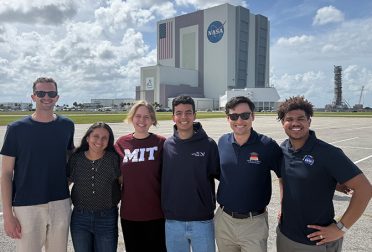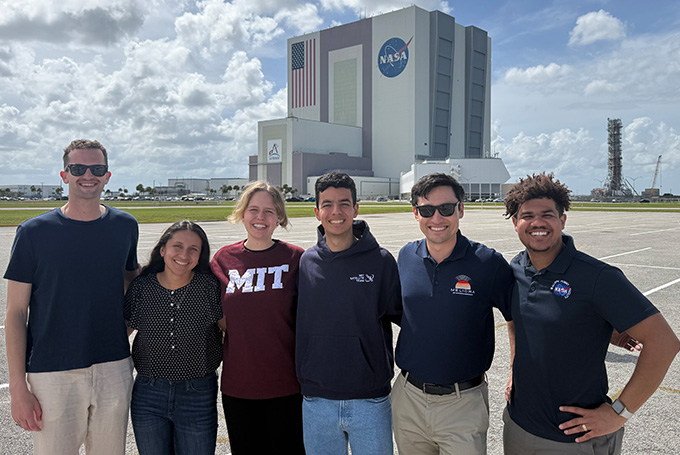
The NASA Revolutionary Aerospace Systems Concepts – Academic Linkage (RASC-AL) Competition challenges teams of undergraduate and graduate students to develop concepts for systems and technology to be used in future space exploration and operation. At the 2026 competition, a team co-led by Clayton Lieberman SDM ’24 and Katiyayni “Kati” Balachandran SDM Certificate ’25 won second place overall and best in theme for their project designing communications, position, navigation, and timing (CPNT) architectures for Mars surface operations. “Our approach was rooted heavily in the SDM curriculum, specifically the system architecture side,” Clayton says.
The team’s project, Mars Exploration Layered Infrastructure for Operations, Research, and Advancement (MELIORA), proposes a constellation of satellites that act as a communications relay and GPS for a base on Mars. The design could also be tested with a lunar base in alignment with NASA’s strategy to prove technology on the Moon first. The group of seven students broke into subgroups for system design, communications, and position and navigation. “Given that our team size was very small, we quickly realized that people would have to wear multiple hats,” Kati says. The team met weekly through the fall and winter and created a proposal document that was submitted in February. Once their proposal was selected as a finalist, they had only seven weeks to complete a technical paper and poster as well as create and polish a presentation. The full project was delivered at the 2026 RASC-AL Competition Forum in Cocoa Beach, FL in early June.
System architecture as a field has strong ties to aerospace and aviation. The SDM team members found their education in the subject helped the whole team move forward. Clayton and Kati, along with fellow SDM students Thomas Harrington and Zachary Barnes, suggested the system architecture techniques they had learned to the other team members as methods that could help the team figure out their strategies. “Once we got past the barrier of explaining the tools and processes, there was a decent amount of buy-in from everyone,” Clayton says. For example, the team wanted to explore the full trade space to find the most effective design. So they modeled over 5,000 constellation geometries and then used Pareto optimization methods to find the design that was Pareto dominant – offering the greatest performance at a lower cost. “Pareto optimization was a concept that I only learned and became familiar with in SDM Core, so that was applicable for us in this challenge,” Kati says. She also noted that verification and validation helped the team explain how they would mitigate risks in their proposal. Thomas agreed on the value of the core and curriculum when approaching this project. “This competition really values a systems framing of the problem and prioritization of goals, and I felt that it gave our team an edge,” he says.
The project also aligned with Clayton’s thesis research. He planned to write about satellites around Mars but initially centered on atmospheric and surface observation. It was his thesis advisor George Lordos, an SDM alum and research scientist in MIT’s Department of Aeronautics and Astronautics and SDM, who alerted Clayton to the announcement of the RASC-AL themes. George had participated in a previous RASC-AL challenge while working on his doctoral dissertation and suggested Clayton do the same with his SDM thesis. Clayton refocused his research onto communications, position and timing for a Mars satellite architecture. Due to the timing of his thesis submission he was working slightly ahead of the MELIORA team. “A lot of times they ended up aligning with where I was headed, and that reassured me that what I was doing for my thesis made sense,” Clayton says. The team was also able to reuse the simulation he built to assess a given constellation’s effectiveness in their project work.
The full MELIORA team included one AeroAstro doctoral student and two AeroAstro undergraduates. The combination of undergraduates and graduate students from multiple departments brought strength to the group’s work. The undergraduates were able to bring their own expertise, such as more recent experience with technical courses. Ekaterina Tiukhtikova, a dual major with Course 6 (EECS), built a full visualization tool using Python that displayed the satellites in orbit around Mars and highlighted each orbit. “We were fortunate to have a mix of students who all brought valuable skills to the table, whether it was optics domain knowledge or coding,” Thomas says. Clayton and Kati both also spoke to the high ability of the team members regardless of department and of everybody’s readiness to accept good ideas no matter the source. “Our team was very aligned,” Clayton says. “While some people were more knowledgeable in one area or the other, everyone was very willing to listen and accept each other’s expertise, and we all agreed on how to handle things.”
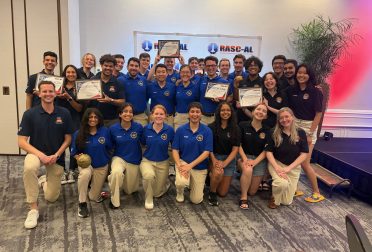
The teams gathered to present their projects at the competition forum in Florida. Clayton said it was a great experience, particularly talking with the other teams about their approaches. “Our designs had converged a lot,” he says of the Virginia Polytechnic Institute and State University team, which placed third overall. “They used different processes to come to their architecture, but there was a shocking amount of overlap between the two solutions.” The MELIORA team placed second overall, behind another MIT team, and also won best in theme for their specific challenge. MELIORA will be presented at the American Institute of Aeronautics and Astronautics SciTech Forum in January of 2027. While Clayton has graduated from SDM and Kati has completed the graduate certificate, they both spoke to the enduring value of participating in the RASC-AL challenge. “I almost feel like you learn more through this kind of experience than lectures, because there’s so much interaction with others. And it’s so interdisciplinary that you can grasp a lot of things in a short amount of time,” Kati says. Thomas felt the project was an important part of his first-year experience as well, saying “This was a great experience for me to meet and work with not only second-year SDMers, but also people outside the program.”
The full MELIORA team:
Team leads: Clayton Lieberman and Katiyayni Balachandran (SDM), Ekaterina Tiukhtikova (undergraduate, AeroAstro and EECS), Celvi Lisy (AeroAstro). Team members: Thomas Harrington and Zachary T. Barnes (SDM), Asael Acosta (undergraduate, AeroAstro). Student co-advisor: Lanie McKinnery (AeroAstro). Faculty: Kerri Cahoy (lead), Jeffrey Hoffman and Olivier de Weck (AeroAstro), and George Lordos (AeroAstro and SDM).