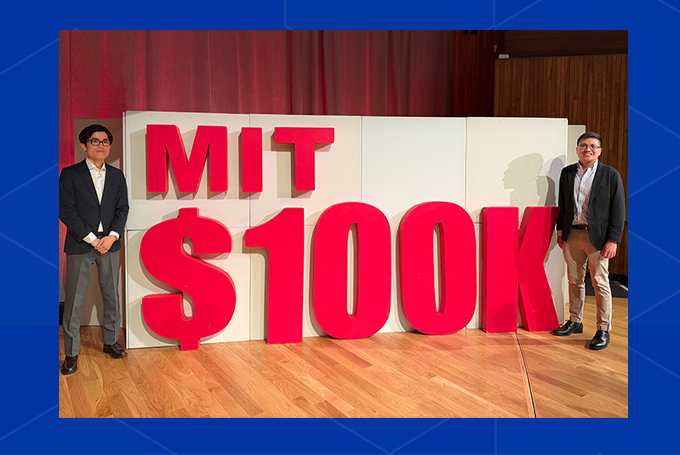
Hiroki “Hiro” Ogasawara and Rowell Castro’s venture DesignFlowAI has been selected as a finalist in the 2026 MIT $100K Entrepreneurship Competition. The competition is MIT’s flagship event for startups.
Hiro and Rowell met when they joined the System Design and Management program as master’s students in 2023. They first collaborated on a project for the SDM core class, working with classmates on updated designs for hydrogen refueling stations. The two continued to work together in MIT hackathons and in courses such as 2.156 (Artificial Intelligence and Machine Learning for Engineering Design). The initial idea for DesignFlowAI took shape in 2025 in 15.390 (Entrepreneurship 101: Systematic Approach to New Venture Creation) taught by Bill Aulet.
In his work as a design engineer at Toyota, Hiro encountered the complexity of modern automotive engineering. Vehicles can contain up to 30,000 discrete parts. As a designer, finding information on those parts can be challenging and take up a great deal of time. The frustration embedded in discovering the intent of initial design choices for these individual parts spurred the creation of DesignFlowAI.
The startup company’s proprietary technology works inside commercial computer-aided design software and surfaces information such as design standards and manufacturing constraints for the exact feature an engineer is working on.
“Most retrieval systems today operate at the document layer. Engineering knowledge is deeply tied to the design itself, including geometry, manufacturing constraints, and past decisions. We are building on the idea that retrieval should be grounded in the context of the engineering artifact itself,” Rowell says.
SDM’s student body is comprised of engineers from a wide range of disciplines. The founding DesignFlowAI partners come from different backgrounds and bring their own experiences to the company’s concept. Hiro has worked at Toyota in body design engineering as well as at Apple as a product designer through the Riccio-MIT Graduate Engineering Leadership Residency Program, with experience in hardware and computer-aided design software. Rowell worked as a digital innovations manager at Shell. His MIT thesis on semantic learning in engineering design directly informs how DesignFlowAI structures and reasons over domain knowledge.
“The serendipity of SDM is meeting the brightest cohort across the world. I’m honored to collaborate with Rowell,” Hiro says. “He brings his expertise in digital transformation at Shell and AI/ML depth through MIT classes, which are fundamental pieces of what we are building now.”
The MIT 100K competition consisted of three contest rounds and featured around 80 MIT startups. By the semifinal stage, only 16 startups remained. These ventures are developing solutions across areas including artificial intelligence, healthcare, manufacturing, robotics, and other emerging technologies. “Most of the startups were backed by large labs at MIT, and it felt very competitive and daunting at first,” said Rowell and Hiro. “However, as the rounds progressed, we were able to challenge ourselves in refining our idea and how we communicated DesignFlowAI’s value. Reaching the finals stage gave us confidence that our approach of building a solution around a practical engineering problem could stand alongside ventures emerging from some of MIT’s most advanced research environments.”
The MIT $100K Entrepreneurship Competition is one of MIT’s annual flagship entrepreneurial events. Past finalists include HubSpot, Akamai, and iRobot.