

David Brown has always been fascinated by our planet. He earned a B.A. in geography and an M.S. in earth sciences. He’s even worked as a land surveyor. Now David is a geophysicist in the energy industry, earning a master of science in engineering and management from SDM. His thesis fused this background in earth science and his interest in sustainability and renewable energy by addressing the hot topic of geothermal energy systems.
Two courses inspired David’s thesis journey. Energy Systems for Climate Change Mitigation, taught by Jessica Trancik, piqued his interest on energy storage, a common problem for renewable energy sources. And in Olivier De Weck’s class Technology Roadmapping and Development, David worked on a team project about geothermal energy. He had previously worked on feasibility studies on geothermal power at his job, so he was excited by the opportunity to explore the subject further.
Geothermal power plants draw on naturally occurring heat below the earth’s surface to generate electricity by using the heat of an underground reservoir to create steam that spins turbines. The steam can be condensed back into water, which is then sent back down to the reservoir via an injector well to be heated back into steam, creating a continuous loop. Once the electricity is generated, it can be stored in a number of ways. As David looked into these storage systems for his project in De Weck’s course, he found them flawed and even possibly dangerous. “Some of them involve pressurizing the reservoir. As a geophysicist, I immediately worry about induced seismicity,” he says, recognizing a risk of earthquakes. Additionally, the parts of the system that require energy to operate like the injector wells can diminish the total output of the power plant, a phenomenon known as “parasitic load.”
Then David remembered his time working in the Piceance Basin. This area of western Colorado features valleys with surrounding mesas that rise 2,000 feet over the valley floor. Furthermore, the deep wells already drilled in the basin show temperatures of over 400 degrees Fahrenheit, more than enough heat to run a geothermal plant. David’s idea was to place water tanks at the top of the mesas, connecting them to the wells in the valley below. By using gravity to the system’s advantage, far less energy would be needed to pressurize the water injected back into the wells. When demand for energy was low, the power plant could pump the water back uphill to the tanks. And when the demand for energy was high, there would be less parasitic load because the gravity would be supplying nearly half of the hydraulic pressure needed to inject water into the geothermal reservoir.
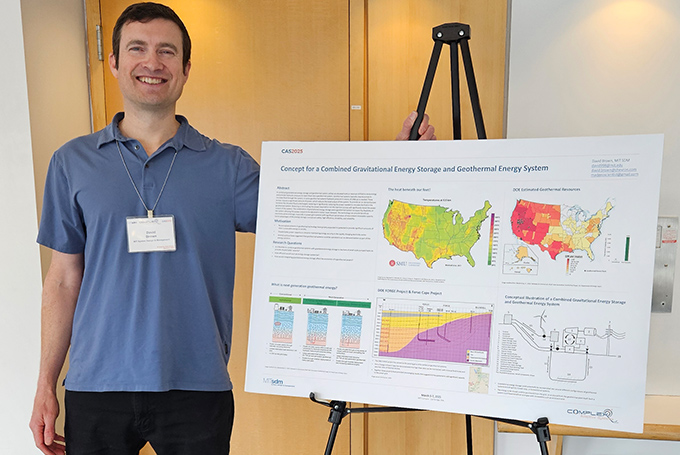
An SDM thesis can be written on almost any topic. Joan Rubin, SDM’s executive director and one of David’s thesis advisors, thought the combination of two complex systems – water tower energy storage and geothermal energy – made an excellent candidate for a thesis. In addition to looking at the emergent properties arising from the combination itself, David used trade spaces as a guide when modeling his hypothetical combined system. “I really like trade spaces, and I wanted to do something along those lines to get at the economics of scale, and to see how that looks in a real-world facility,” he said. Besides the support of his thesis advisors, David also gained useful feedback from presenting a poster on his research at the Complex Adaptive Systems conference held at MIT in March of 2025.
Now that David has graduated, he’s shared his research with people working in geothermal energy. Alexander Slocum, professor of mechanical engineering and the co-advisor of David’s thesis, said: “David did an excellent job of combining detailed mechanical design considerations with economic analysis and showed that his hypotheses was correct. The result is particularly important for more remote regions that rely on geothermal energy for electric power generation.” Future research in this area could focus on a number of factors David looked at like parasitic load, temperature maintenance, and water management. “When I started this, I knew it would work, but I didn’t know if it was economically viable,” he said. “At the end of the day, I’d say my thesis suggests that it warrants further investigation.”