by Stefanie Koperniak
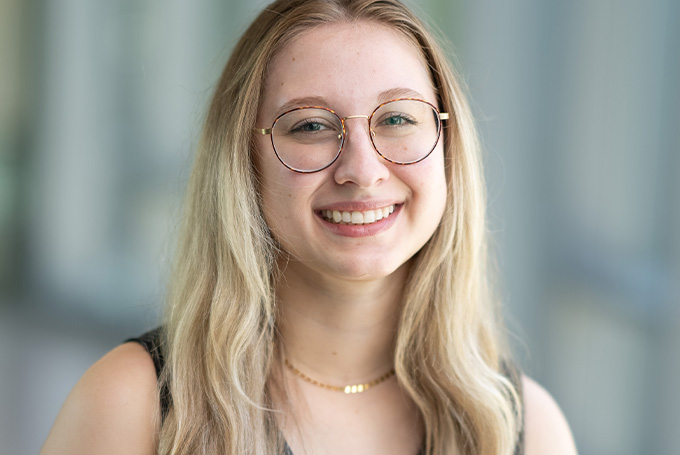
First-year SDM student Kelly Cody’s journey to SDM begins with the story of her becoming a co-founder of Periodic, a company innovating smart dispensers of pads and tampons.
The inspiration for the company was rooted in Cody’s experiences with outdated period product vending machines, including at a late night in a lab during her graduate studies in biotechnology at the University of Texas at Dallas.
“I was in a state-of-the art lab—in a brand-new building on a modern campus—and I couldn’t use the bathroom dispenser because it was coin-operated,” says Cody. “Just down the hallway, there was a line of vending machines with candy bars and snacks accessible with a debit or credit card. The juxtaposition was striking. I thought, ‘Why is this not better?'”
After graduating with a master’s degree from UT Dallas, where she had also earned a bachelor’s degree in biology, Cody worked briefly in regulatory pharmaceutical consulting. She had moved to Boston and wanted to try working in an entirely different sector. With a passion for debate, both participating in debate growing up and helping coach while she was in grad school, she began working for the Boston Debate League. At this non-profit, she helped to provide resources and opportunities to public school students interested in debate. She also met Austin Essex (then a volunteer for the Boston Debate League with a business background), who ended up becoming the other co-founder of Periodic.
Cody says that although she hadn’t initially set out to be an entrepreneur, the problem of the lack of advancement in period care vending machines persisted—and continued to linger in her mind. She and Essex began researching, and she worked on the company for several years while working at the Boston Debate League. She ultimately began working for Periodic full-time, and applied to the SDM program.
“I realized that there were some technical skills that I was still lacking,” says Cody. “A lot of what we do is hardware and manufacturing, and although I have science skills, I didn’t have the ‘right’ ones. I felt like I was missing some of the more comprehensive business skills, as well.”
Finding support at MIT to bring down barriers
Cody has found MIT to provide a strong entrepreneurial ecosystem, including through the Martin Trust Center for MIT Entrepreneurship and the Priscilla King Gray (PKG) Center for Social Impact. She also feels that the SDM program has been very helpful as she shapes and grows her company.
“The staff has been really supportive whenever I want to talk about the various barriers of my business,” says Cody. “Everyone has such a wide array of experience in industry. The curriculum has been really interesting, as well. I’ve learned to take a comprehensive view of how dispensers have come to be the way that they are, taking a step back and looking at why and how certain decisions were made.”
Cody has recently returned from an Innovation Discover Japan (IDJ) Tech Trek, during which MIT students and researchers visit technology companies and research institutes in Japan.
“One thing that stood out to me on the IDJ trip was how innovative and ubiquitous Japan’s restroom and vending infrastructure is,” says Cody. “Advanced toilet technology is standard there, which really underscores that what we choose to put in bathrooms is a societal prioritization, not just a budget decision. There were also drink vending machines everywhere, which reinforced for me that dispenser convenience can become normalized when it’s treated as essential infrastructure.”
Tackling logistical problems with a systems approach
Traditionally, there have been two types of dispensers on the market: one that is brand-specific, created by a company and made for only their own products, and one that allows for different brands of products, but requires some type of intermediary packaging to go around each individual product (such as boxes or cardboard tubes).
“It’s a logistical hassle,” says Cody. “It’s extra expensive to repackage all of these things, and it involves using extra material for no reason.”
Periodic currently has two different lines of dispensers. One is a simple steel box, similar to a basic paper towel dispenser. The other, which is still in development, has more features and adjustability. The aim is to have the products available at no cost to users, paid for by the facility—just like toilet paper and paper towels.
“We worked with a design firm and created a dispenser that is internally adjustable. It can dispense whatever you put in it,” says Cody “It doesn’t have any intermediary packaging. It also has some additional functionalities of being able to inform facilities staff if it’s empty or jammed.”
Cody notes that there has been a legislative shift to mandate that period care products be available in various spaces, with more than half of states requiring availability of the products in some way. This policy focuses mostly on places like universities, government buildings, shelters, and prisons. In addition, there is a larger societal expectation for other venues, such as stadiums and other public events spaces, to also provide this for consumers.
“Periodic is addressing a variety of systems problems, and many people underestimate how complex these systems actually are,” says Cody. “SDM is helping me to approach systems more methodologically and to learn to be a bit more adaptable.”